

The uses of woven geotextiles have grown significantly as modern infrastructure projects increasingly demand greater strength, durability, and long-term performance. Roads, railways, drainage systems, and embankments constantly face challenges such as soil instability, water damage, erosion, and structural stress.
To address these challenges, engineers are increasingly relying on advanced woven geotextile solutions that improve ground stabilization, enhance load distribution, and strengthen overall structural performance. Their role in reinforcement, separation, filtration, and erosion control has made them an essential component in modern civil engineering and infrastructure development.
This blog explores the major uses of woven geotextile, along with its key functions, practical applications, and growing importance in today’s evolving construction and infrastructure landscape.
Woven geotextiles are high-strength permeable fabrics manufactured by weaving synthetic fibers or tapes into a durable and stable structure. Widely used in civil engineering and infrastructure projects, they help improve soil stabilization, reinforcement, separation, filtration, and drainage performance. Their strength and durability make them an effective solution for roads, railways, embankments, retaining structures, and erosion control applications.
With rapid urbanization and expanding infrastructure development, modern construction projects have become more complex, demanding stronger ground stability, higher durability, and improved load management.
While traditional stabilization methods served as the foundation of ground preparation for decades, engineers today are increasingly preferring woven geotextiles as a smarter, more efficient, and technically advanced solution for modern infrastructure projects.
Several evolving infrastructure challenges have significantly accelerated the adoption of geotextiles across modern civil engineering and construction projects worldwide.
Modern highways and industrial zones handle heavier traffic loads, requiring woven geotextiles to improve load distribution and structural stability.
Rapid urban development increasingly requires construction on weak soils where woven geotextiles provide essential reinforcement and ground stabilization support.
Modern infrastructure projects prioritize durability and reduced maintenance, making geotextiles important for extending structural service life efficiently.
Woven geotextiles help reduce aggregate requirements, improve construction efficiency, and minimize long-term repair and maintenance related project expenses.
As engineering standards evolved and research advanced, the proven performance of geotextiles in reinforcement, filtration, and drainage drove their widespread adoption across modern infrastructure projects.
Geotextiles support sustainable infrastructure by optimizing material usage, reducing resource wastage, and improving long-term environmental performance in construction projects.
Engineered for demanding civil engineering applications, woven geotextiles deliver a distinctive set of technical properties that ensure strength, stability, and reliable long-term performance across diverse infrastructure projects.
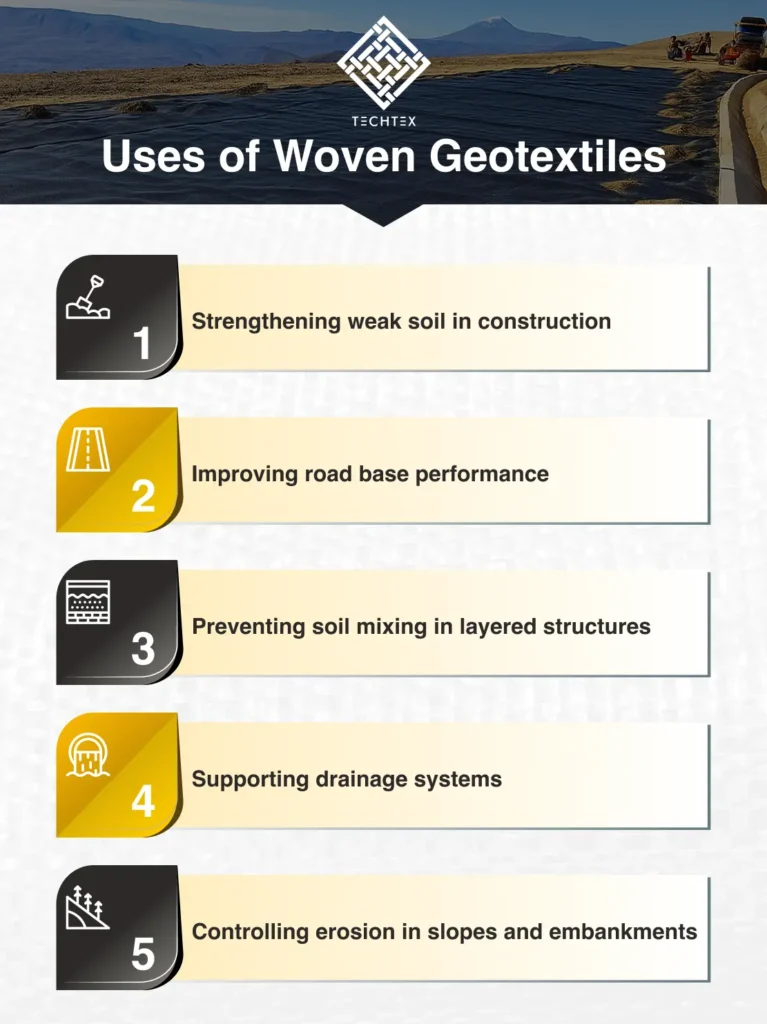
Woven geotextiles are widely used across diverse modern infrastructure projects for improving ground stability, strengthening foundations, and supporting long-term structural performance across diverse construction applications.
Woven Geotextiles improve load distribution within weak and unstable soil layers, enhancing ground stability, reducing settlement, and providing reliable long-term reinforcement.
Installed beneath road surfaces, woven geotextiles separate aggregate from weak subgrade layers, reducing displacement and improving pavement durability under continuous heavy traffic movement and heavy loads.
Woven geotextiles act as a separation barrier, preventing intermixing between layers and preserving long-term structural performance efficiently.
Their controlled permeability allows efficient water flow while retaining soil particles, preventing clogging and improving drainage system performance and foundation stability.
Woven Geotextiles stabilize exposed slopes and embankments, reducing soil displacement and improving erosion resistance across highways, coastal protection areas, and elevated terrain infrastructure projects.
As infrastructure projects continue to grow in scale and complexity, woven geotextiles play a crucial role in improving ground performance, enhancing structural durability, and supporting long-term construction efficiency.
Road surfaces experience continuous pressure from vehicles and environmental exposure. Geotextiles improve load distribution and reduce rutting, extending pavement lifespan significantly.
Soil erosion weakens foundations and damages landscapes around infrastructure systems. Woven geotextile uses in civil engineering help maintain soil stability in vulnerable locations.
Proper filtration supports efficient drainage performance by preventing clogging and controlling soil migration. This contributes to safer and more reliable infrastructure systems.
Infrastructure repairs can become expensive when soil failure or drainage problems occur. Geotextiles reduce long-term maintenance requirements by improving foundational stability from the beginning.
From transportation networks to erosion control systems, woven geotextiles are widely used across diverse infrastructure applications where strength, stability, and long-term ground support are essential.
These fabrics are commonly installed beneath roads and pavements to reinforce weak foundations and enhance long-term surface durability.
Railway tracks require stable foundations capable of handling repeated vibration and heavy axle loads. Geotextiles help maintain track alignment and minimize settlement.
Filtration capabilities make woven fabrics suitable for drainage channels, retaining structures, and irrigation projects.
Shoreline protection systems frequently rely on geotextile applications in infrastructure designed to resist erosion and wave action.
Geotextiles assist in separation and containment within landfill systems, supporting environmental protection and operational efficiency.
Despite numerous advantages, proper selection and installation remain critical. Incorrect material choice may reduce effectiveness under specific load or drainage conditions. UV exposure during prolonged storage can also impact performance before installation.
In addition, poor site preparation may limit the fabric’s ability to deliver expected reinforcement results. Careful engineering evaluation is necessary to maximize long-term efficiency.
As infrastructure demands continue increasing, geotextiles are expected to play a larger role in sustainable development practices. Future innovations may include stronger polymer technologies, improved filtration performance, and environmentally responsible manufacturing methods.
Growing investments in highways, smart cities, railway expansion, and coastal protection systems will likely increase demand for advanced ground stabilization solutions. This ongoing evolution highlights the expanding relevance of woven geotextiles across global construction industries.
Woven geotextiles have become a smart solution for modern infrastructure projects requiring strength, stability, and long-term performance. Their role in reinforcement, drainage, filtration, and erosion control continues to support durable, cost-effective, and sustainable construction across evolving civil engineering applications.
As engineering standards continue to evolve, Techtex remains committed to delivering high-performance, precision-engineered woven geotextile solutions for civil engineering projects worldwide.
Woven geotextile is a highly durable synthetic fabric, engineered by interlacing polypropylene or polyester threads. Its high-tensile strength and minimal stretch makes it suitable to reinforce weak ground, separate construction layers, and support drainage flow, improving foundation stability, minimizing surface deformation, and increasing the lifespan of roads, embankments, and other load-bearing infrastructure projects.
The woven geotextiles are commonly used in highways, railway foundations, retaining structures, embankments, drainage channels, landfills, and coastal protection projects. Their ability to stabilize soft ground and control erosion makes them valuable in demanding construction environments. Large infrastructure developments rely on these materials to improve durability, reduce settlement risks, and maintain reliable ground performance over time.
Engineers use woven reinforcement fabrics beneath roads to strengthen subgrades and prevent aggregate layers from mixing with soft soil. This improves load distribution, reduces rutting, and extends pavement durability under constant traffic pressure. They also support moisture control and drainage efficiency, helping road surfaces remain more stable, reliable, and resistant to long-term damage caused by environmental exposure.
Geotextiles strengthen weak ground by distributing structural loads more evenly across the surface. They help reduce displacement, minimize settlement issues, and improve foundation support in demanding construction areas. By maintaining separation between different soil layers, they increase ground stability and allow roads, embankments, and heavy-load structures to perform more efficiently under continuous pressure.
Woven varieties are produced by interlacing materials like polyester or pp tapes, creating a strong structure mainly used for reinforcement and load support applications. Non woven alternatives are manufactured using bonded fibers and are commonly selected for filtration and drainage purposes. In simple terms, one focuses more on strength and stabilization, while the other is designed primarily for water movement and filtration.
Yes, the woven geotextiles are engineered for demanding long-term construction applications. They provide excellent tensile strength, puncture resistance, chemical durability, and stability under harsh environmental conditions. Their ability to maintain reinforcement and filtration performance for extended periods makes them suitable for transportation networks, erosion control systems, drainage projects, and large civil engineering developments.
Get quick, personalized home service quotes.