

Choosing the right PP woven fabric for GCL construction is not a small decision. It sits underneath a geosynthetic clay liner, supporting the clay core and holding the whole system together under load. Get the specifications wrong, and the entire liner can perform below expectation, no matter how good the bentonite is. This guide walks through what PP woven fabric does inside a GCL, the ten parameters worth checking before you commit to a GCL manufacturer, and where material choice tends to go wrong in practice.
PP woven fabric is a geotextile made from polypropylene tapes or yarns, interlaced in a grid pattern much like a basic textile is loomed. That construction gives it high tensile strength along both directions of the sheet, along with good dimensional stability. In geotechnical work, this type of GCL geotextile is valued because polypropylene resists most soil chemicals and doesn’t absorb moisture, which helps it hold its mechanical properties over long service periods.
A geosynthetic clay liner combines a layer of sodium bentonite with two textile layers, usually one woven and one nonwoven, bonded together through needle punching. The clay does the actual work of the hydraulic barrier, swelling when hydrated to close off water and contaminant flow. The surrounding layers hold that core in place, add strength to the composite, and let the finished GCL liner be handled, transported, and installed without shifting or spilling.
Inside a GCL, PP woven fabric typically serves as the carrier, the base the clay is spread onto during production. This component has to be strong enough to support the weight of the core and hold together during needle punching. It also affects how the finished product behaves once installed, particularly its resistance to tension during placement and its performance on slopes. In effect, the GCL carrier layer can contribute significantly to the reinforcement and overall stability of the composite.
The woven structure gives the clay a stable base during manufacturing. As needle punching happens, fibres from the nonwoven cover get pushed through the bentonite and into the woven layer, locking it between the two components so it doesn’t shift or separate during normal handling.
The woven carrier takes on most of the tensile load in a GCL, so its strength shapes how the liner performs during installation, especially on slopes where forces build up along the seams. A strong enough carrier keeps the composite intact under stretching and uneven ground contact.
How much pulling force the material can take before failing, which matters most during installation on slopes and at seams.
Stretch too far before breaking, and the liner can deform under load, so elongation values need to stay within a predictable range.
Grams per square metre affects strength and durability, but GSM alone doesn’t tell you everything about GCL fabric specifications.
A thicker sheet generally resists abrasion better, though it should be balanced against flexibility and ease of installation.
Sites with stones or debris need a geotextile that can withstand localised pressure without tearing through.
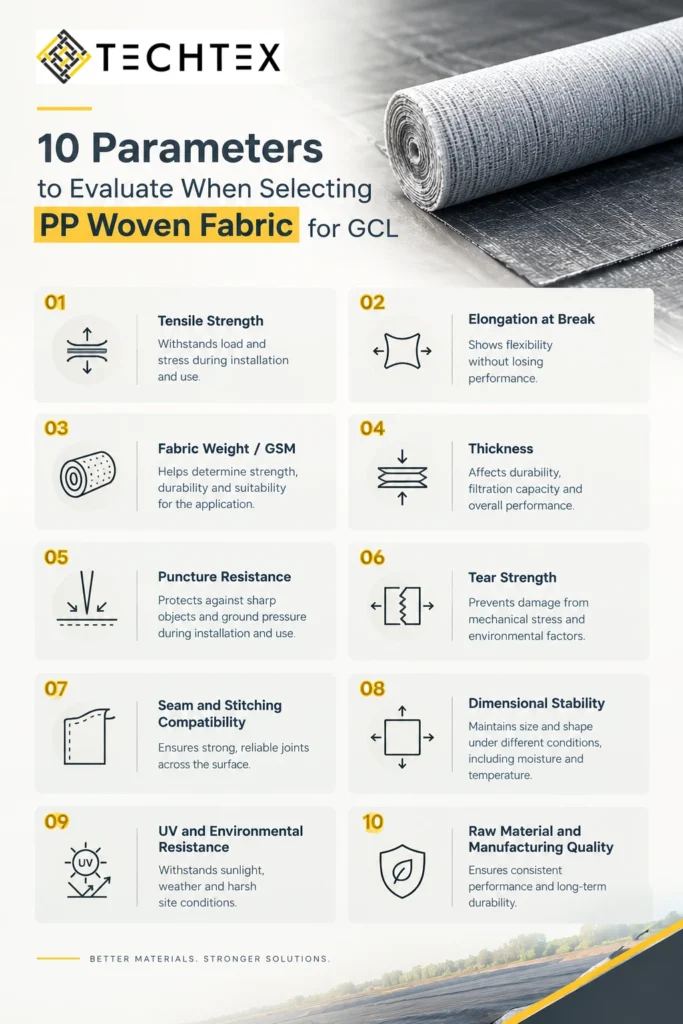
Once a small nick starts, this property decides whether the damage spreads or stays contained, which matters a great deal on rough subgrades.
The material needs to hold a stitch or bond cleanly at overlaps, without fraying or loosening during handling and installation.
A textile that shrinks or stretches with temperature changes can throw off overlap widths and seam integrity after installation.
Even with limited exposure before burial, the weave needs enough UV stabiliser to avoid degrading during storage and installation windows.
Virgin polypropylene resin, consistent yarn diameter, and controlled weaving tension all affect how reliably a batch performs, and these are the details that separate careful GCL manufacturing from a rushed production run.
Matching GCL specifications to the project in front of you, rather than copying a generic data sheet, is what actually determines field performance.
A landfill liner and a pond liner don’t face the same stresses, so the specifications chosen should reflect the actual site, not a generic default.
Slope angle, equipment traffic, and subgrade roughness each place different demands on the carrier, and specifications should account for the harshest condition expected on site.
A textile that’s easy to fold, transport, and seam in the field cuts down on installation errors, which matters as much as raw strength numbers on paper.
Weight alone doesn’t guarantee strength or puncture resistance, and relying on it as a shortcut often leads to underperforming liners.
A cheaper roll can mean lower fibre quality or inconsistent weaving, and that tends to show up as problems later in manufacturing and installation.
The carrier needs to work effectively with the clay and cover component during needle punching, not just meet strength specifications in isolation.
Specifications written without site data in hand tend to miss real world stresses the material will actually face.
Look for a GCL manufacturer who can share test data on tensile strength, puncture resistance, and dimensional stability rather than general marketing claims. Consistent production quality across batches matters more than one strong sample, since performance comes down to every roll meeting the same standard. It’s worth asking about raw material sourcing, quality control checks, and whether they’ll support custom PP woven fabric specifications for specific project needs.
Woven and nonwoven geotextiles behave differently under load. Woven fabrics tend to get picked where higher tensile performance and dimensional stability matter most, while nonwoven fabrics usually offer better cushioning and puncture protection.
Projects with rocky subgrades or heavy equipment traffic may benefit from a thicker nonwoven cover paired with a woven carrier, rather than relying on one geotextile for GCL across every component.
Material choice influences far more than the finished spec sheet. It shapes how easily a GCL installs, how well it survives handling before burial, and how the composite behaves once buried under years of load and settlement. A properly selected carrier keeps the clay core contained and the composite stable through handling, installation, and years of service.
PP woven fabric may sit underneath the more visible bentonite component, but its specifications play a real role in how a geosynthetic clay liner performs, from manufacturing and installation through years in the ground. Evaluating a GCL fabric on strength, puncture resistance, dimensional stability, and manufacturing consistency, rather than price or GSM alone, gives project teams a liner suited to real site conditions.
A GCL typically uses two geotextile layers around a bentonite core, often combining woven and nonwoven fabrics. The woven layer can act as the carrier, while the nonwoven layer helps contain the bentonite and supports the needle punching process.
PP woven fabric is used because it offers good tensile strength, dimensional stability, and resistance to moisture and many soil chemicals. In a GCL, it can support the bentonite during manufacturing and contribute to the strength and stability of the finished liner.
There is no single GSM suitable for every GCL application. The required fabric weight depends on the GCL design, bentonite content, strength requirements, manufacturing process, and installation conditions. GSM should be evaluated along with tensile strength, thickness, puncture resistance, and other key properties.
Important properties include tensile strength, elongation at break, GSM, thickness, puncture resistance, tear strength, dimensional stability, and environmental resistance. Consistent raw material quality and controlled manufacturing are also important for maintaining reliable fabric performance across different production batches.
Tensile strength shows how well the fabric can withstand pulling forces without failing. In GCL applications, suitable tensile performance helps the carrier maintain its integrity during manufacturing, handling, transportation, and installation, particularly when the liner is placed on slopes or exposed to installation-related loads.
Selection should begin with the GCL design, application, and site conditions. Consider factors such as slope angle, subgrade roughness, equipment traffic, handling, and mechanical loads. The fabric’s strength, thickness, GSM, puncture resistance, and dimensional stability should then be matched to these requirements.
Testing should match the required GCL specifications and project conditions. Key properties commonly evaluated include tensile strength, elongation, puncture resistance, tear strength, thickness, GSM, and dimensional stability. Depending on storage, installation, and service conditions, environmental resistance may also need to be evaluated.
Yes, PP woven fabric can be produced to meet specific GCL requirements. Depending on the application, specifications such as GSM, thickness, tensile properties, and other performance characteristics can be adjusted. Customization should be based on the GCL design and supported by consistent manufacturing and quality testing.
Get quick, personalized home service quotes.